
Product comparison
Galvanized vs PVC-Coated Flexible Conduit: How to Select the Right Spiral
The metal core may look similar, but the jacket, temperature range and expected exposure lead to different choices.
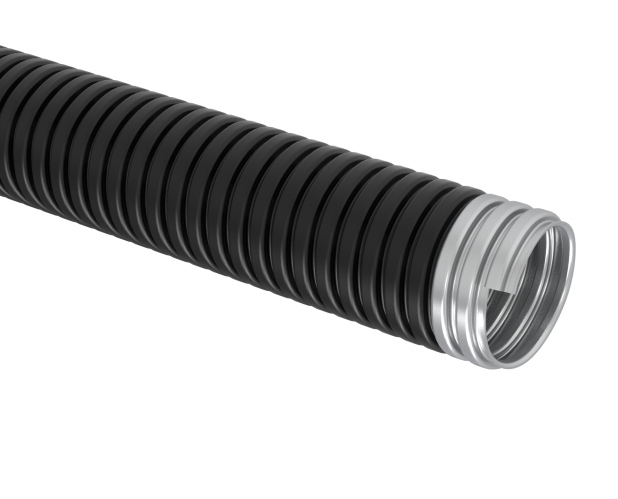
Compare galvanized and PVC-coated flexible steel conduit by environment, protection, temperature, diameter, bend radius and coil length.
Begin with the installation environment
Bare galvanized flexible steel conduit is suitable where mechanical flexibility and higher temperature capability are priorities and the installation does not require the additional PVC jacket. PVC-coated galvanized conduit adds an external barrier that is useful where moisture, dust and surface contact need greater protection.
The selection should be based on the complete assembly—conduit, connector and termination—not on the conduit name alone. The protection level of an installation can be limited by an incompatible fitting or poor termination.
Compare the declared working data
FRAME lists its PVC-coated PSB series with a declared IP54 description and a temperature range of -20°C to +70°C. The galvanized CSB series is listed as IP40 and -20°C to +220°C. These figures make the trade-off clear: the coating supports environmental protection, while the uncoated metal series serves higher-temperature applications.
Always confirm the current technical sheet for the exact diameter and project. Temperature, compression resistance and ingress protection should be checked together with the specified connectors and installation method.
- PVC-coated PSB: additional outer jacket
- Galvanized CSB: higher declared upper temperature
- Both ranges: check compatible fittings and bend radius
Select by metric diameter, not only by inch name
Trade sizes can be described in metric millimetres and nominal inch equivalents. The actual internal and external diameters are the values that determine cable fit and connector compatibility. A 32 mm product should be checked against its stated internal and external dimensions rather than assumed from the trade label.
Bend radius also increases with diameter. Tight routing that works for a small coil may not be possible with a 63 mm or 102 mm conduit. Plan the routing before ordering large diameters.
Use coil length in the quantity calculation
Smaller flexible conduits are commonly supplied in longer coils, while larger diameters use shorter coils for handling. FRAME references from 9 mm to 21 mm use 50-metre coils; selected larger sizes use 25, 15 or 10 metres. Convert the route total into full coils for each diameter and include installation waste.
A mixed quotation should show the diameter, series, coil length and number of coils. That format is easier to check than one total metre figure covering multiple products.
Frequently asked questions
Quick answers for purchasing teams
Is PVC-coated conduit always better than galvanized conduit?
No. It offers a different protection profile, while the uncoated galvanized series can suit higher-temperature environments. Select by the declared conditions of use.
Can the same connector be used for both ranges?
Do not assume so. Match the connector to the conduit outer diameter, construction and required ingress protection.